Complete Guide to Build and Tune in Forza Horizon 6
Like we said in the review of this game, there are big changes between the fifth and sixth series, especially in Build and Tune in Forza Horizon 6 which affects how players customize their cars for better speed and handling. Here, continuing our Forza Horizon 6 game guides, I'm gonna check out the different angles of Build and Tune, though these changes might not be final yet and we could see more updates.
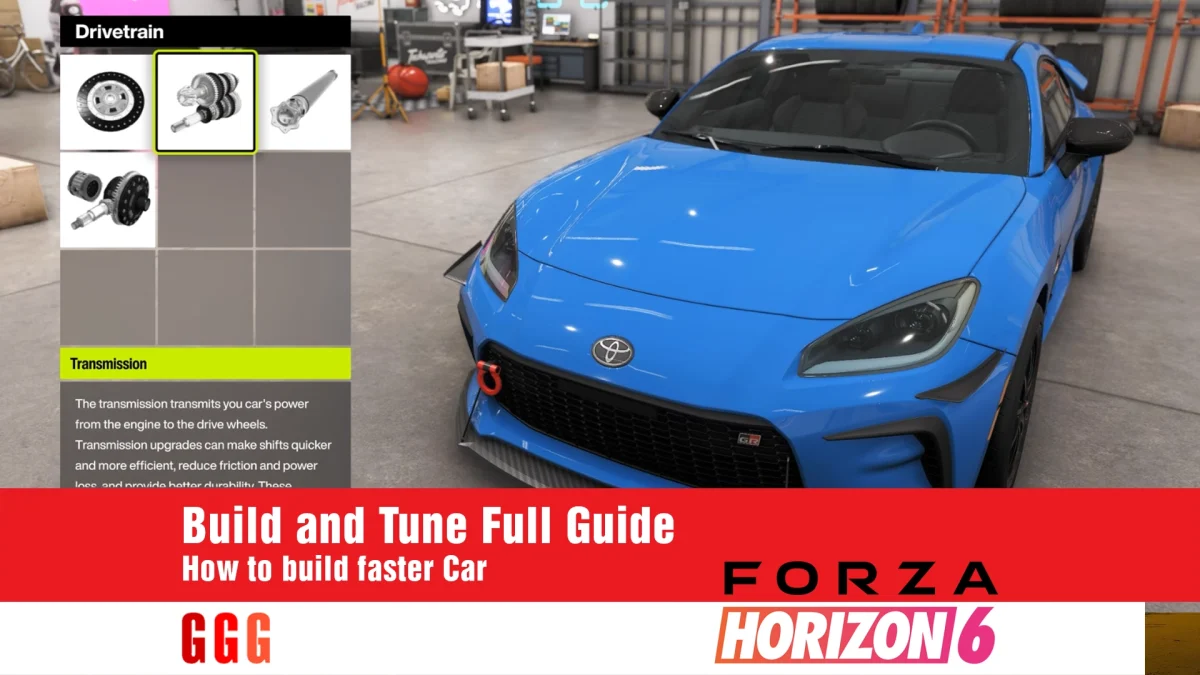
How to upgrade cars in Forza Horizon 6?
My suggestion is that when upgrading cars, it's better to keep them in the same class or at most two classes higher. Try to prioritize upgrades on parts that have tuning options like differentials, then focus on the right tire compound, aerodynamics, and suspension. Focus your PI cost priority on reducing weight, then spend the rest on power. So let's get into the categories of Build and Tune in Forza Horizon 6.
Engine Swaps & drivetrain
In Forza Horizon 6, Engine Swaps still have a big impact on the game but different conditions affect it. Now balance and weight reduction have more effect on handling. For Build and Tune in Forza Horizon 6, I recommend using V8 swaps for speed races where engine power is the priority. Otherwise, it's better to use factory engines or lightweight swaps with higher power band at high RPMs.
Next up is drivetrain. In lower to mid classes, AWD drivetrains are totally fine. In higher classes like A class, RWD can keep things competitive for you. For offroad races, it's better to use AWD.
Build and Tune in Forza Horizon 6: Tires and brakes
In the sixth Forza Horizon game, tires and brakes got big changes. The range of effectiveness for tire compounds is way wider now. To put it simply, bad tires got worse and good tires got better. My advice to you is to upgrade your front tire width cause it has a big impact on your gameplay experience.
Key things for tire upgrades
For AWD and RWD cars in lower classes, regular or street tires are enough
In mid classes for asphalt tracks, it's better to use Rally and Drift tires cause they perform better than Sport tires
In higher classes especially for RWD, it's better to use Semi-Slick and Full Slick tires
Keep in mind that with your PI, always upgrade front tire width at least one level
Brakes in Forza Horizon 6
Stock brakes perform poorly and cause wheel lockup during things like downshifting. For lower to mid class cars that have regular brakes, do at least one level of brake upgrade with your PI.
ARBs, suspension, and anti-roll bars
In this series, we're seeing lots of changes to car handling which means we need to prioritize stability. My suggestions for suspension in Build and Tune in Forza Horizon 6 are:
Try to adjust your ARBs so your mechanical balance reaches around 0.55 to 0.65. Keep in mind that the higher this number is, the more front grip you have compared to the rear.
Spring stiffness should go opposite to your ARB settings. Meaning if you lowered the front ARB, you should increase front spring stiffness to keep stability and balance.
If while driving, when entering a corner your car locks up and you lose the rear, stiffen the front springs.
Ride height settings
Just like in FH5 where you had to pick max height to avoid a suspension softness penalty, in FH6 it's pretty much the same.
Aerodynamics and brake balance
Unlike FH5 where you ran the most downforce in the front and the least in the rear, in FH6 mechanical grip and stability are higher priority and you need to balance them. My advice to you is to set your front and rear balance around 0.42 to 0.45. Simply put, the more downforce you choose, the better your car is for drag racing, so adjust the amount based on the track.
Brake balance has more impact in FH6. If you push the slider toward the front, you get more stability but more chance of lockup. If you push it toward the rear, you get more instability. Don't mess with these settings too much.
Differential settings in Forza Horizon 6
My suggestion for differential settings is that for AWD cars, don't set the center diff below 50%. The higher you set this, the more power goes to the rear and creates oversteer.
For RWD, set acceleration diff between 50 and 60, and deceleration between 10 and 20. Keep in mind that the lower you set deceleration, the more rotation you get in corners, but this also causes more instability.
Build and Tune in Forza Horizon 6 summary
If we look at Build and Tune in Forza Horizon 6 overall, it looks somewhat similar to FH5 but with the difference that now you have more settings available to customize your car how you like it and in the best way possible. The impact of tires and brakes in the game has increased, and car stability while driving can determine the outcome of a race. The tighter and narrower the track, the more these factors show their effect.